


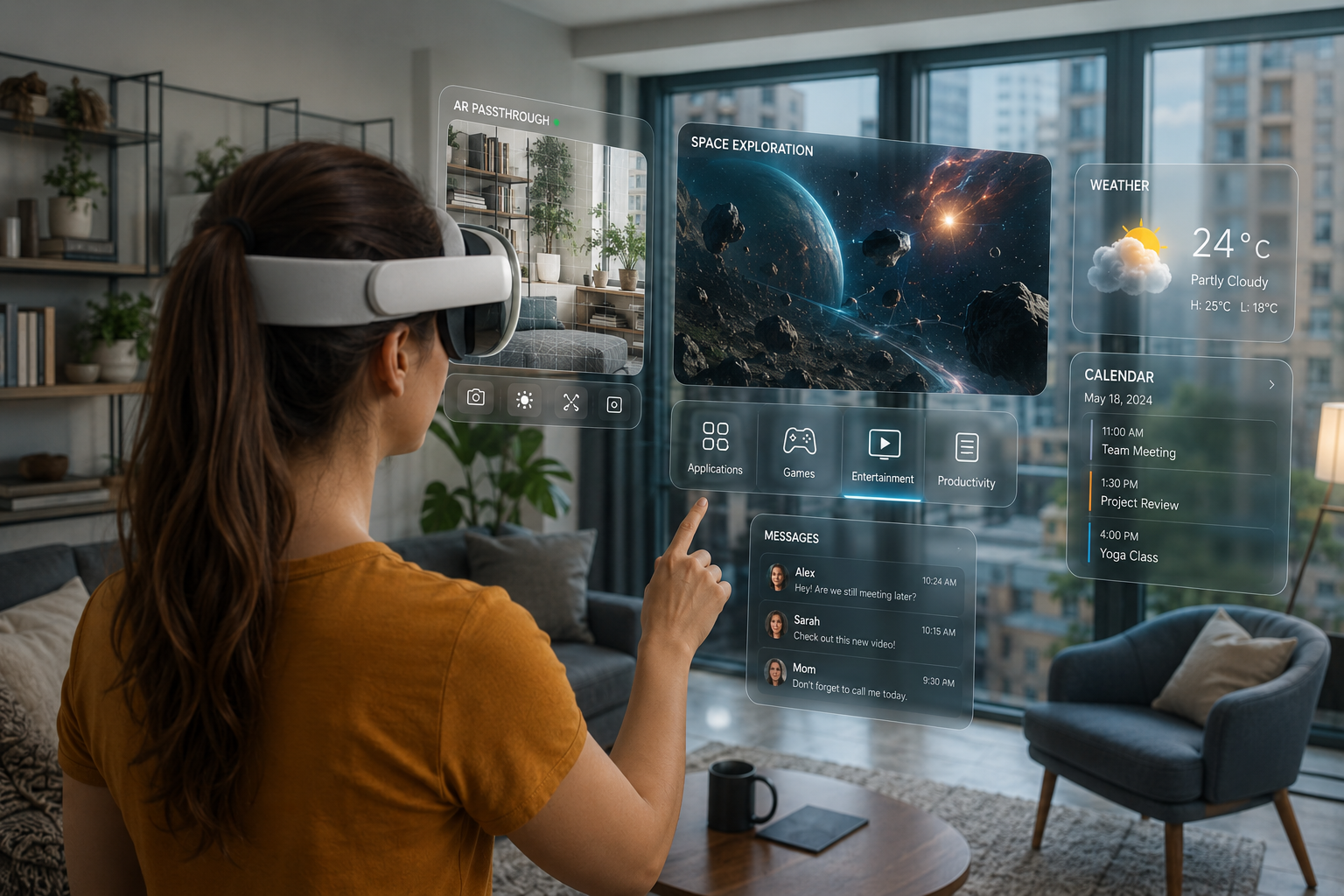
Virtual reality has come a long way from being a niche technology used mainly by gamers and technology enthusiasts. Modern VR headsets can now blend digital content with the real world, creating experiences that feel more interactive, natural, and immersive. One of the technologies helping drive this change is AR passthrough.
AR passthrough allows users to see their physical surroundings through cameras built into a VR headset while digital elements are displayed over the real environment. This combination of real and virtual content is opening new possibilities for entertainment, gaming, communication, education, and digital experiences.
What Is AR Passthrough?
AR passthrough is a feature that uses cameras on a VR or mixed-reality headset to capture the user’s surroundings and display that view inside the headset.
Instead of completely blocking out the physical environment, the headset creates a digital representation of the user’s surroundings. Virtual objects can then appear alongside real-world furniture, walls, people, and other elements.
This technology makes it possible to move between fully virtual and mixed-reality experiences without necessarily removing the headset.
For example, a user could see a virtual screen floating above a real desk, interact with a digital object in their living room, or watch immersive entertainment while still maintaining awareness of their surroundings.
How Does AR Passthrough Work?
The basic process involves several hardware and software components working together.
Cameras Capture the Environment
The cameras positioned on the headset capture images of the area around the user. These cameras provide the visual information needed to recreate the surrounding environment.
Software Processes the Visual Information
Advanced software processes the camera feed and identifies important features of the environment. This may include surfaces, walls, objects, and the user’s position.
Digital Elements Are Added
Once the environment has been processed, virtual objects and interfaces can be placed within the user’s surroundings.
The result is a mixed-reality experience where digital content appears to exist within the physical world.
Motion Tracking Improves the Experience
Modern headsets also track movement. When the user moves their head, virtual objects can remain positioned in the same location relative to the surrounding environment.
This stability is an important part of creating a convincing immersive experience.
AR Passthrough vs. Traditional VR
Traditional VR generally places the user inside a completely digital environment. The physical world is largely hidden, allowing the user to focus entirely on virtual content.
AR passthrough takes a different approach.
Instead of replacing the physical environment, it incorporates that environment into the experience. Users can interact with virtual content while remaining visually connected to their surroundings.
Both approaches have advantages.
| Feature | Traditional VR | AR Passthrough |
|---|---|---|
| Physical environment | Mostly hidden | Visible through cameras |
| Digital immersion | Very high | High |
| Real-world awareness | Limited | Greater |
| Virtual objects in real spaces | Limited | Strong |
| Mixed-reality applications | Limited | Excellent |
The choice between the two depends on what the user wants to accomplish.
Why AR Passthrough Matters for Entertainment
Entertainment is one of the areas where passthrough technology can have a major impact.
Instead of consuming digital content on a flat television or monitor, users can experience content in a more spatial environment.
Virtual screens can appear larger than physical displays. Digital environments can surround the viewer, and interactive elements can respond to movement.
This creates opportunities for new forms of entertainment that combine traditional video with immersive technology.
Platforms and websites exploring immersive video are also helping demonstrate how VR can change the way people experience digital entertainment. For example, users interested in AR passthrough videos and immersive VR entertainment can explore specialized VR content through platforms such as VRSpy.
The important development isn’t simply that videos are being viewed through a headset. It’s that the technology allows digital content to become more spatial and interactive.
AR Passthrough and VR Videos
VR video has traditionally focused on creating a 360-degree viewing experience. The viewer can look around a digital scene instead of being limited to a fixed camera angle.
Passthrough technology adds another layer.
Rather than placing the viewer entirely inside a recorded environment, passthrough can allow digital video and visual elements to coexist with the user’s physical surroundings.
This could make entertainment feel more personal and flexible.
Imagine watching a virtual performance while sitting in your own living room, with digital elements positioned around the room. The physical environment remains part of the experience instead of disappearing completely.
Benefits of AR Passthrough
There are several reasons why passthrough technology is becoming increasingly important.
1. Better Environmental Awareness
One major advantage is that users can remain aware of their surroundings.
This can be useful when someone needs to check their physical environment without completely removing the headset.
2. More Flexible Experiences
Users can move between virtual and mixed-reality experiences depending on what they want to do.
A headset can therefore become more than a device for playing VR games.
3. New Entertainment Formats
Content creators can experiment with interactive and spatial entertainment formats that aren’t possible on traditional screens.
4. Improved Productivity
Passthrough can also support productivity. Users may place virtual monitors, applications, or other digital tools around their real workspace.
This can potentially turn a small physical area into a much larger virtual workspace.
5. More Natural Mixed Reality
As tracking and camera technology improve, digital objects can interact more convincingly with the physical environment.
This helps create a stronger connection between virtual content and real-world spaces.
AR Passthrough in Gaming
Gaming is another major application for mixed reality.
Instead of entering a completely virtual game world, players can interact with virtual characters and objects within their actual surroundings.
A living room could become part of the game environment. A virtual object might appear on a real table, while digital characters could move around the player’s physical space.
This creates a different style of gaming where the boundary between the real and digital worlds becomes less obvious.
Developers can also design experiences that adapt to different rooms and environments, potentially making games more personalized.
AR Passthrough for Education
The technology has potential beyond entertainment.
Educational applications could use passthrough to place three-dimensional models into real environments.
For example, students could examine a virtual model of the human body, explore a historical artifact, or study a three-dimensional representation of a scientific concept.
This approach may make abstract ideas easier to visualize.
Instead of reading about a complex object in a textbook, students could potentially interact with a digital representation of it.
The Role of Mixed Reality
AR passthrough is closely connected with the broader development of mixed reality.
Mixed reality combines physical and digital environments so that virtual objects can appear to exist within real spaces.
As headset hardware improves, mixed reality is becoming more practical for everyday applications.
Better cameras, improved tracking, faster processors, and more accurate spatial mapping can all contribute to a better experience.
The goal is not necessarily to make virtual reality replace the real world. Instead, mixed reality aims to make digital content work naturally alongside it.
Privacy and Security Considerations
While AR passthrough offers many benefits, privacy should also be considered.
Headsets with cameras can capture information about the user’s surroundings. Depending on the device and software, environmental data may be processed to understand walls, furniture, rooms, and other physical features.
Users should therefore pay attention to privacy settings and understand what information their devices collect.
It is also important to use reputable applications and keep headset software updated.
As mixed reality becomes more common, privacy standards and responsible data practices will remain important parts of the technology’s development.
Challenges Facing AR Passthrough
Despite its potential, the technology still has limitations.
Camera Quality
The quality of passthrough depends heavily on the headset’s cameras. Poor camera quality can make the physical environment look less natural.
Latency
There needs to be very little delay between real-world movement and what appears inside the headset.
Even small delays can reduce comfort and make the experience feel unnatural.
Battery Life
Advanced cameras, processors, displays, and tracking systems can consume significant power.
Improving battery efficiency remains an important challenge for headset manufacturers.
Comfort
Headsets need to remain comfortable during extended use. Weight, heat, fit, and display quality can all influence the overall experience.
Cost
High-quality mixed-reality hardware can still be expensive, which may limit adoption among casual users.
What Does the Future Hold?
The future of AR passthrough is likely to involve smaller, lighter, and more capable devices.
As hardware improves, users may experience better visual quality and more accurate tracking without needing bulky equipment.
Artificial intelligence could also play a larger role. AI systems can help headsets understand physical environments, recognize objects, and respond more intelligently to user actions.
This could lead to mixed-reality applications that feel increasingly natural.
Entertainment may become more interactive, workplaces may use virtual displays more extensively, and educational experiences could become more visual and hands-on.
How Content Creators Can Adapt
The growth of mixed reality also creates opportunities for content creators.
Traditional video creators can explore spatial storytelling, immersive video, 360-degree content, and interactive experiences.
Instead of designing content for a flat screen alone, creators can consider how viewers will experience the content inside a three-dimensional environment.
This requires new creative approaches.
Camera positioning, spatial audio, viewer movement, and interaction can all become important parts of the storytelling process.
AR Passthrough and the Next Generation of Digital Entertainment
Digital entertainment has continually evolved alongside technology.
Radio introduced mass audio entertainment. Television brought moving images into homes. The internet transformed how people access information and media. Smartphones made digital content available almost everywhere.
VR and mixed reality represent another step in that evolution.
AR passthrough is particularly interesting because it doesn’t require users to completely leave the real world behind. Instead, it creates a bridge between physical surroundings and digital experiences.
That flexibility could make mixed reality useful for a much wider audience.
Final Thoughts
AR passthrough is helping redefine what people can expect from VR and immersive entertainment. By combining camera-based views of the physical environment with digital content, it creates experiences that are more connected to the world around the user.
The technology still has challenges involving privacy, hardware, battery life, comfort, and cost. However, continued improvements could make passthrough increasingly useful across entertainment, gaming, education, communication, and productivity.
For users interested in exploring how passthrough technology is being used for immersive video and digital entertainment, platforms such as VRSpy provide examples of content designed around these emerging VR experiences.
As mixed reality continues to develop, the distinction between physical and digital entertainment may become less important. The future could be less about choosing between the real world and virtual reality—and more about bringing the two together in useful and creative ways.
